Why AI Comes Last
Geology first. Physics second. Data third. Then AI. The order matters more than the algorithm.
 Chicheng Xu, PhD · Founder & Chief Scientist
·
·
6 min read
We have all seen it: a model that predicts permeability, water saturation or lithofacies from well logs with an impressive R². The plots look clean. The validation score is high. Then the model meets a new well, and it falls apart.
When that happens, the failure is usually not in the algorithm. It sits in what came before it: a geological assumption nobody wrote down, a physical effect nobody corrected for, or data that were never calibrated. The machine learned exactly what it was given.
So at OpenPetro we work in a fixed order. Geology first. Physics second. Data third. Then AI. This is not a slogan against AI. I have spent much of my career building machine learning for subsurface data, and I believe in it. It is a statement about where AI belongs in the stack: on top, carried by everything underneath.
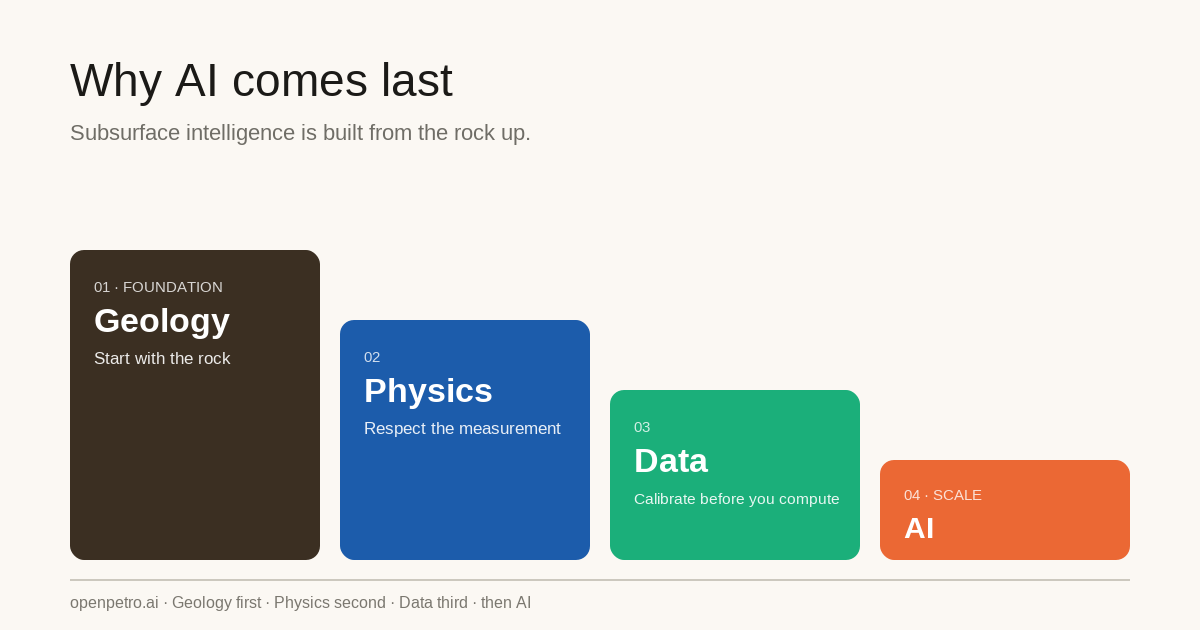
1 · Geology: start with the rock
A well log is a one-dimensional record of a three-dimensional geological story. The same gamma ray value means different things in a deltaic sand, a turbidite and a carbonate ramp. The same porosity can hold a fast macroporous sand or a microporous rock that will barely flow. Depositional environment, diagenesis, structure and stratigraphy decide which relationships are even meant to hold.
Skip this step and a model will happily average across facies that should never share a correlation, or carry a trend from one compartment across a fault into another. Geology tells you which question to ask and where an answer is allowed to apply.
2 · Physics: respect the measurement
Logging tools do not measure porosity, saturation or permeability. They measure count rates, voltages, travel times and relaxation signals, which we then translate through physics. A density tool responds to electron density; a resistivity tool responds to every conductive path, including clay-bound water; an NMR tool responds to hydrogen in an environment of a given surface relaxivity.
Each translation has assumptions, and each assumption has a domain where it fails: Archie in shaly sands, a sonic transform across a gas effect, a GR-based shale volume in a feldspathic sand. Physics tells us which signals carry information and which are artefacts of the borehole, the tool or the environment. A model that never learned the physics will learn the artefacts instead.
3 · Data: calibrate before you compute
Only now does the data question make sense, and it is rarely a question of quantity. A thousand wells with un-normalized gamma ray, inconsistent units, depth shifts between runs and washed-out intervals are not a big dataset. They are a big problem.
Good subsurface data work is unglamorous: environmental corrections, normalization across vintages and vendors, depth matching core to log, honest flags on bad hole, and calibration against the ground truth we do have, from core, capillary pressure, formation tests and production. Calibrated data with clear uncertainty beats more data every time.
4 · AI: then make it scale
With geology, physics and data in place, AI does what it is genuinely good at. It reads thousands of wells consistently. It finds patterns no one has time to look for. It turns a week of interpretation into minutes, and it lets experts spend their time on the decisions instead of the drudgery.
Built this way, AI inherits the structure underneath it. Geological context becomes features and constraints; physics becomes model form, priors and sanity checks; calibrated data becomes a training set worth trusting. The result is a model that is explainable, because every prediction can be traced back to rock, physics and data, and one that is far more likely to hold up in the next well.
Why the order matters
Reverse the order and the cost shows up late, in the field, where it is most expensive. A model trained before the geology is understood gives confident answers in the wrong places. A model trained before the physics is respected learns tool and borehole effects. A model trained before the data are calibrated reproduces their errors at scale. In each case AI does not fix the problem; it hides it and multiplies it.
Put in order, each layer makes the next one cheaper and more reliable. That is why AI comes last: not because it matters least, but because it is the layer that gives back exactly what the others put in.
What this looks like in practice
- We start projects with the rock: core, cuttings, analogues and the geological model, before any curve is touched.
- We write the physics down: which tool responses, which corrections, which equations, and where each one stops being valid.
- We treat data preparation as engineering: normalization, QC and calibration are documented deliverables, not hidden steps.
- We build AI that can explain itself, with physics-informed features and checks, so every prediction can be audited by a geologist or petrophysicist.
Our free learning tools follow the same idea. Each one is tagged with the layer it teaches: the GR motifs tool is about geology, the Archie lab about physics, the Flow Unit Lab about calibrated data.